|
S |
M |
T |
W |
T |
F |
S |
|
1
|
2
|
3
|
4
|
5
|
6
|
7
|
|
8
|
9
|
10
|
11
|
12
|
13
|
14
|
|
15
|
16
|
17
|
18
|
19
|
20
|
21
|
|
22
|
23
|
24
|
25
|
26
|
27
|
28
|
|
|
Forums10
Topics39,866
Posts566,806
Members14,629
| |
Most Online9,918
Jul 28th, 2025
|
|
|
|
Joined: Jan 2002
Posts: 785 Likes: 12
Sidelock
|

Sidelock
Joined: Jan 2002
Posts: 785 Likes: 12 |
Welcome to the gunshop.com HyperNews Bulletin Board System! Feel free to use this system to discuss your doubles, drillings, combination guns, other fine firearms, and related material. The rules are really simple: Stay on the subject matter, keep it clean, and contribute answers when you can!
Have Fun...and thank you for participating....:-)
gunshop.com home | Sponsors | Gun Rack | Book Rack | Useful information
The Brew -- actually two successive soaks
Forum: The gunshop.com Double Gun BBS
Re: Question for Zaphod on stripping a stock............(more) (Don Nolan)
Date: Mar 01, 13:45
From: JohnM
There have been repeated request for this on various BBS's. I had occasion to rewrite it, cause I couldn't find my file. So, if any of you have mislaid this useful little procedure, here 'tis:
The "Wonko the Sane" method for stripping oilsoaked gunstocks and finishes
~~~~~~~~~~~~~~~~~~~~~~~~~~~~~~~~~~~~~~~~~~~~~~~~~~~~~~~~~~~
Foreword from JohnM:
My training in antique furniture repair is as conservator -- the most preservation with the least damage. Regarding the restoration of military relics and old guns, an Enfield BBS discussion about "sacrilege!" defined exactly, that there is a fine dividing line between (1) stabilizing the decline of the object, (2) achieving and preserving a stable, well-cared for appearance that doesn't obliterate the object's history, and (3) "Ooopsie! It's really frigged up now. Kiss the history and value goodby!".
A lot of what you do depends on the object itself: how bad is it and is it getting worse? What then, is your restoration goal? How will you achieve it without going past it? I see a great deal of merit for a good, nondestructive cleaning of wood and metal. Excess amounts of petroleum oil are particularly destructive to stock wood. A useful substance for an overall cleaning, found here in the 'States is called D&L Hand Cleaner. [This is NOT conservation approved by the twinkle-toed museum set, BTW! ;~`)]
"D&L" is a nonabrasive, stiff white jell, that is sold in a widemouth can at autoparts stores for hand cleaning. Do NOT try to use the orange, gritty stuff or other pumice and abrasive hand cleaners. The homogenized petroleum solvents, detergents, and surfactants in the D&L will get a LOT of crud off. I'd be interested to hear of it's effect on old cosmoline, should anyone want to try it. Rinse with common paint thinner and rub dry.
For the most severe cases, I think the following procedure { WONKO's } is the least destructive, but the most complete: because -- the oven cleaner, dish washer, sandpaper and steel wool, et. al. are all much harder on the wood and historic surfaces and they all have some failings. I will be very happy to correspond with folks who try this, as an old military rifle provides the greatest cleaning challenge of which I'm aware, so far as pure grease, grime, dirt, soaked in petroleum [wood-eating!] oil, and excessive finish.
I cribbed this off the Shooting Sportsman board a couple of years ago, posted by a now-departed fellow named "Wonko the Sane" Hope it proves useful. Save as a word doc, because I won't. ;~`). This is more or less as i remember it. Any rudeness must certainly be mine. ;~`)
~~~~~~~~~~~~~~~~~~~~~~~~~THE METHOD~~~~~~~~~~~~~~~~~~~~~~~~~
Go to the hardware store [or chemist, for the Brit's] and buy a gallon of acetone and a gallon of denatured alcohol. It's relatively cheaper than retail paint strippers.
~~~~~~~~~~~~WARNING~~~~~~~~~~~~~
DANGER!!!: READ THIS NOW!
The stuff BLOWS UP if you assist it to do so.
Don't make sparks, smoke 'whatever',place by hot water heaters and furnaces or otherwise make it go boom. OK?
It's the READER'S responsibility NOW.
Don't kill your family by fire, just because you won't care enough to read and heed prominently posted warnings regarding the use and storage of potentially hazardous articles. Also, use good VENTILATION: the furnace room in wintertime is a poor place to be doing this. You need some fresh air circulation.
NOTHING PERSONAL!
WHY this method? It's prob'ly the SAFEST METHOD I know of, given the few elementary precautions to be followed. The materials have a relatively low toxicity rating (TLV - Threshold Limit Value). They are safer to handle and use, chemically speaking, then most retail strippers. AND they do a great job with virtually zip work by you. From a preservation standpoint, it leaves the wood undamaged.
~~~~~~~~~~~~~~~~~~~~~~~~~~BEGIN~~~~~~~~~~~~~~~~~~~~~~~~~~~~~~ You need (1) a big, cheap FUNNEL from the auto parts store. You should have a batch of (2) nitrile or latex GLOVES -- pinch 'em from the doc or dentist; they'll just spend the money on shotguns anywayz. (3) a pair of safety glasses or GOGGLES -- y'all can figure that one out, right? You need (4) a PAN made of stainless steel, or porcelain, or other non-reactive material which is big enough to hold the wood from which you wish to remove the oil/and or finish. Find something that won't dissolve in the acetone for (5) a tight COVER [no plastics]. Plywood cut to shape and held down with a brick or spring clamps work.
Ideas: The funnels are useful for pouring things about. Paint strainers (paint store or hardware where you got the solvents) help keep the gunk out of the cleared solvents by putting them in the funnels when you do the pouring. The gloves keep the stuff from being absorbed thru yer hide.
First: Put the stock wood in the pan and carefully pour acetone over it, until it is generously covered. Put on the lid. Turn the floating wood over in a couple of days. Again. Leave it for a week, total. The finish should be pretty much gone. Take the wood out and pour off the acetone into a container, where all the gunk will settle to the bottom in a week or so. Pour the clear acetone back in the can it came in. Reuse it as needed.
Second: Now put the wood back in the clean pan and cover it with Alcohol. Same drill for a week. The wood should now be clean right down in every li'l pore, and suitable for glassing the stock head, repairing cracks, applying new finish, and the rest. The alcohol can be cleared by precipitation and time, same as before, and reused.
Last: I like to take some clean alcohol and a small natural bristle brush to scrub up the piece, directly I pull it out. Then, rinse and dry with a clean towel. No sanding needed; the wood should be smooth as....[a baby's butt!;~`)]... could be. It preserves the stamped markings and doesn't raise the grain; or rarely, very little.
HELPFUL STUFF: Sometimes, rarely, this won't clean stuff the first time. [NOTE: Wonko had never tried old SMLE's, so it may take a couple of soaks, indeed!!!] If ever it doesn't look as though the finish let go into the acetone, the first time, drain it off. Give it another week of fresh acetone. This is also useful for really deeply soaked-in gun oil. Then use the alcohol soak, same as above. No, or very, little sanding needed, the wood will be smooth. ~~~~~~~~~~~~~~~ Go from there -- Then say thanks to St. Wonko the Sane. Sacrifice some flyers in his memory, [He was a pigeon-ring shooter] , and put on the finish of your choice. I've heard clarified yak butter is the traditional thing, on the Himalayan rock pigeon circuit. ~~~~~~~~~~~~~~~
to: "The Brew -- actually two successive soaks"
--------------------------------------------------------------------------------
gunshop.com home | Welcome | Sponsors | The Gun Rack | The Book Rack | SxS Video Gallery
Enter Our Monthly Lottery | Order or request more information | Other Useful Information
Updated Everyday! DCW -Copyright (c ) 1999, gunshop.com
mailto:davew@gunshop.com
|
|
|
|
|
Joined: Jan 2002
Posts: 674
Sidelock
|
|
Sidelock
Joined: Jan 2002
Posts: 674 |
I started using Easy Off for stripping stocks and removing oil back in the '80's. I was in high school and I think I got the tip from Guns and Ammo. It is very effective for stripping finishes such as those found on Brownings or Remingtons. It does a good job at removing oil from stocks but I no longer use it for that purpose. For a heavily oil soaked stock, you have to dump a lot of lye and water on the wood to get it clean. You will have a bigger mess to clean up, i.e. whiskered and swelled wood at inletting.
I keep a can in the shop for quick stripping, but soak stocks in a solvent for those that are heavily oil soaked.
Please be careful if you use Easy Off or any other spray stripper. When I was 15 I got Easy Off in my left eye while cleaning an oven. It ate 7 holes in my cornea and was incredibly painful. Those of you who know me know what I have been through in life and know that when I say something is painful, it is PAINFUL! But my eye healed up fine and I was back to my 20/15 vision in a few weeks. I got battery acid in my right eye 3 years later and that was a cake walk compared to the lye.
skunk out
|
|
|
|
|
Joined: Jan 2002
Posts: 5,983
Sidelock
|
|
OP
Sidelock
Joined: Jan 2002
Posts: 5,983 |
Thank you all very much. I feel well armed to take on the job at hand. I've refinished several stocks but have not done the acetone soak before.
I appreciate all the suggestions,
> Jim Legg <
|
|
|
|
|
Joined: Feb 2005
Posts: 7,438 Likes: 1
Sidelock
|
|
Sidelock
Joined: Feb 2005
Posts: 7,438 Likes: 1 |
Quote: "I will be very happy to correspond with folks who try this, as an old military rifle provides the greatest cleaning challenge of which I'm aware, so far as pure grease, grime, dirt, soaked in petroleum [wood-eating!] oil, and excessive finish." I couldn't agree with the above more. Pictured below is a Turkish Mauser I purchased a few years ago. Unfortunately I don't have a "Before" picture but this rifle dated 1948 was soaked in both oil and grease and had probably been in storage for half a century. I was taking it on faith that the stock was even walnut* as I couldn't tell from the pictures. To add to the difficulties the importer had apparentely bundled them together for transport using steel bands and creating horrendous dents in the process. I followed the general procedure already covered for using Easy Off and then raised the dents. After that I lightly sanded with 150 grit I believe so keep in mind that this is a military stock. I finished up with two coats of oil. *It was kind of luck of the draw when these Mausers were being imported. Mine has a relatively plain stock but I have seen examples with almost exhibition quality wood. Jim 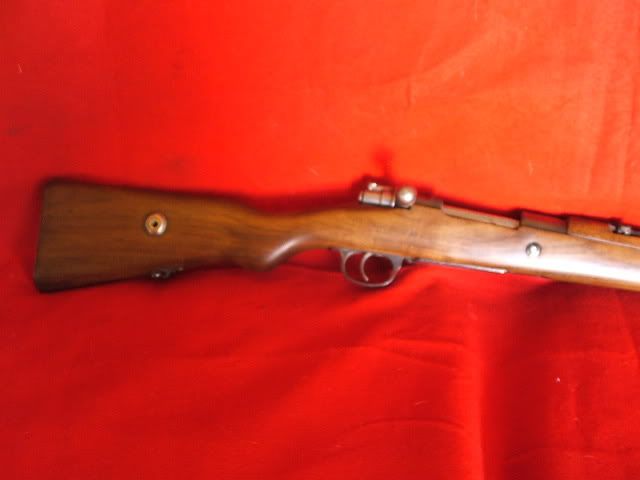 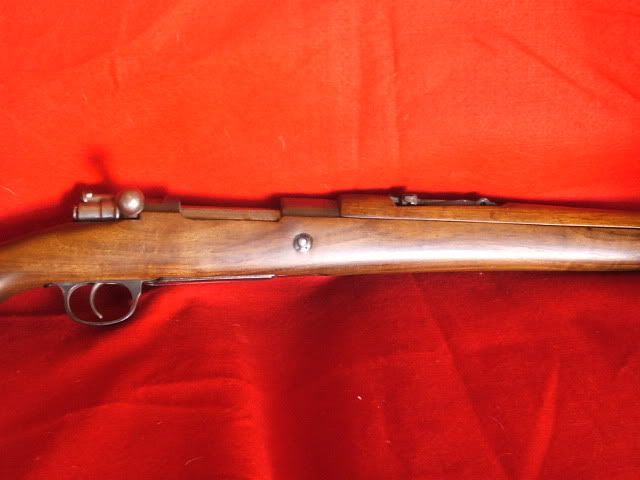
Last edited by italiansxs; 09/20/08 04:31 PM.
The 2nd Amendment IS an unalienable right.
|
|
|
|
|
Joined: Jan 2002
Posts: 5,983
Sidelock
|
|
OP
Sidelock
Joined: Jan 2002
Posts: 5,983 |
Started the acetone soak this afternoon. Will give it a week, as suggested. Weighted the wood down with two strips of lead so turning over should not be necessary. Roaster bag was punctured easily by the toe of the stock so the wood is loose in the pan and the pan is covered with foil.
Thanks again,
> Jim Legg <
|
|
|
|
|
Joined: Jan 2002
Posts: 3,660 Likes: 8
Sidelock
|
|
Sidelock
Joined: Jan 2002
Posts: 3,660 Likes: 8 |
Jim, just in case lead has some reaction during the "bathing" and stains the wood
I'd suggest you use a plate or two (crockery, porcelain) as weights. JMTC
JC
"...it is always advisable to perceive clearly our ignorance."ť Charles Darwin
|
|
|
|
|
Joined: Jan 2002
Posts: 3,660 Likes: 8
Sidelock
|
|
Sidelock
Joined: Jan 2002
Posts: 3,660 Likes: 8 |
Or maybe you already wrapped the lead in tin foil just in case?
JC
"...it is always advisable to perceive clearly our ignorance."ť Charles Darwin
|
|
|
|
|
Joined: Jan 2002
Posts: 5,983
Sidelock
|
|
OP
Sidelock
Joined: Jan 2002
Posts: 5,983 |
I appreciate the warning, JC. I'll look at the lead tomorrow and if it looks questionable, I'll follow your suggestion. Might even use a small glass jar or coffee cup with some lead inside.
Thank you,
> Jim Legg <
|
|
|
|
|
Joined: Jan 2002
Posts: 6,711 Likes: 175
Sidelock
|
|
Sidelock
Joined: Jan 2002
Posts: 6,711 Likes: 175 |
Thanks, Tyler. That was Wonko's method. You notice the name Don Nolan. That was the name I used when I first came on here. Wow!! Has it been ten years? I guess so. But thanks for the info. I have it around here somewhere but have no way of posting it.
|
|
|
|
|
Joined: Jan 2002
Posts: 5,983
Sidelock
|
|
OP
Sidelock
Joined: Jan 2002
Posts: 5,983 |
No sign of damage or staining from or to the lead. Acetone is getting sort of brown. That's normal, I hope.
Thanks again,
> Jim Legg <
|
|
|
|
|

