|
S |
M |
T |
W |
T |
F |
S |
|
1
|
2
|
3
|
4
|
5
|
6
|
7
|
|
8
|
9
|
10
|
11
|
12
|
13
|
14
|
|
15
|
16
|
17
|
18
|
19
|
20
|
21
|
|
22
|
23
|
24
|
25
|
26
|
27
|
28
|
|
29
|
30
|
31
|
|
|
|
|
|
|
2 members (Birdog, Hammergun),
469
guests, and
6
robots. |
|
Key:
Admin,
Global Mod,
Mod
|
|
|
Forums10
Topics39,907
Posts568,203
Members14,640
| |
Most Online9,918
Jul 28th, 2025
|
|
|
|
Joined: Aug 2004
Posts: 411
Sidelock
|

Sidelock
Joined: Aug 2004
Posts: 411 |
I do not calibrate the gauge.It comes with a gauge factor;in this case 2.1.I then go to the Pressure Trace program and enter barrel inside diameter, outside diameter,bullet diameter, barrel length,gauge factor,barometric pressure (in. Hg),temperature (degrees F);units of velocity(ft/sec).The laptop,through Bluetooth,then draws a graph, Y-pressure in psi;X- time in 1/10's of a millisecond(for a 30 in. barrel a total of 3 milliseconds) .The graph allows one to determine pressure from primer firing to exit from the barrel.Fast powders show a graph with the peak at about 4 in. from the breech.Slow powders show a peak at about 6 in. from the breech.However, slow powders show a graph with higher pressures further down the tube than fast powders. Of course,fast vs. slow is somewhat like comparing 1st and 2nd in the 100 yd dash.2nd is slower,but not by much. Since Young's Modulus is about the same for common steels,the strain gauge is designed to do this measurement.
|
|
|
|
|
Joined: Jan 2002
Posts: 2,522
Sidelock
|
|
Sidelock
Joined: Jan 2002
Posts: 2,522 |
William,
Reason I ask the question is your statement that none of your tests got above 10,000 psi is counter to tests by other ballisticians I know that have an industry standard pressure gun and calibrated gauges. You might find it interesting to contact someone like Tom Armbrust and have him send you a few known pressure loads to see how your setup compares. It can only improve your confidence and knowledge. As an alternative you could pressure test some loads in your setup and send several loads from the same lot to Tom and see how they compare that way. He is in that business of testing other folks loads and is really a great guy to deal with.
Last edited by Jerry V Lape; 06/02/11 10:59 PM.
|
|
|
|
|
Joined: Aug 2004
Posts: 411
Sidelock
|
|
Sidelock
Joined: Aug 2004
Posts: 411 |
Cool,but do not forget that the top is 11500 psi.And who are the others?And why are they better than I? Also why not ask the dark side Chuck H if the strain gauge works.I think that he has just a little experience in this matter.If not, do not fly.And if you read my previous post ,I did not compare to the any thing ,but to the company who made the shotshells. And, how do you know the real ability of others? What does Mr.Armburst have to say on this matter?I agree that he is an expert on this matter and a nice person.However, I have had just a little bit of training at UVA and have just a little bit of physics training.Which does not make me a know-it all;just a some-what of an informed idiot.
|
|
|
|
|
Joined: Jan 2002
Posts: 11,574 Likes: 168
Sidelock
|
|
Sidelock
Joined: Jan 2002
Posts: 11,574 Likes: 168 |
Are we talking about peak pressure here? Recalling Bell's "Finding Out for Myself" tests, he used several strain gauges positioned at various points along his test barrel, which is how he got readings from the chamber as well as much farther down the barrel. If you can do that with one strain gauge, wonder why he used several? (Maybe improved technology?)
I submit the above while admitting that I know zilch about strain gauges. But the Bell tests (and I believe also some done by Dupont, going way back before WWII I think) showed peak pressures much closer to the breech--like within the first couple inches--for all powders.
From other information I've seen, those pressures sound low for factory loads.
|
|
|
|
|
Joined: Feb 2003
Posts: 4,120 Likes: 86
Sidelock
|
|
Sidelock
Joined: Feb 2003
Posts: 4,120 Likes: 86 |
It's called 'peak chamber pressure' for an obvious reason.
The peak has come and gone before the shot charge has moved one inch.
"The price of good shotgunnery is constant practice" - Fred Kimble
|
|
|
|
|
Joined: Sep 2009
Posts: 473 Likes: 42
Sidelock
|
|
Sidelock
Joined: Sep 2009
Posts: 473 Likes: 42 |
The peak has come and gone before the shot charge has moved one inch. I always thought that slower burning powders would actually result in peak pressure further down the barrel at say the 6 inch range. Faster burning powders, I've read, in the 4 inch range. The latter is close to what you stated but the former leads me to believe, if what I've read is accurate, that it depends on the the type of powder.
|
|
|
|
|
Joined: Jan 2002
Posts: 2,522
Sidelock
|
|
Sidelock
Joined: Jan 2002
Posts: 2,522 |
William,
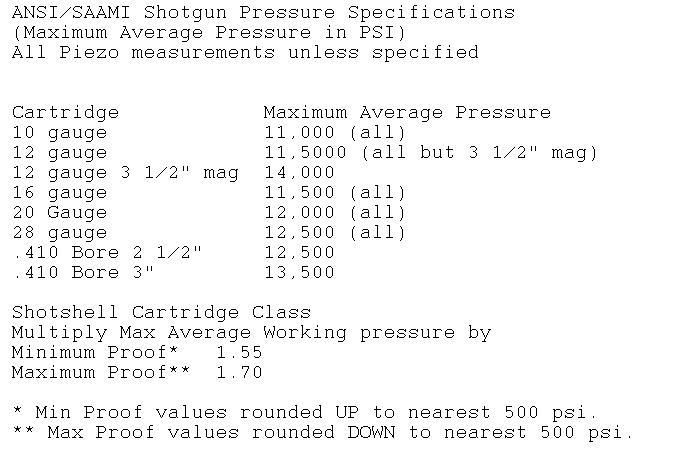
I did not intend to implying you didn't have the acumen to test pressures. But I do know that in any development work on munitions calibration of the setup is mandatory if you want to obtain absolute values rather than relative values. Many times the strain gauges are tested with static pressure using fluids under certifiable pressure to verify the results. I also know that most of the hobbyist setups usually indicate in their manuals the pressures are only relative. Also, the top pressures are not limited to 11,500psi. That is just one of the measures SAAMI specifies and is an average. You can find SAAMI specs on line quite easily. I don't know what Tom Armbrust would say, but suspect he would be quite generous in helping you to achieve a reliable baseline. For just a few dollars you could compare your tests of a few loads against his tests of the same lot which if our roles were reversed would be of great interest to me.
|
|
|
|
|
Joined: Aug 2004
Posts: 411
Sidelock
|
|
Sidelock
Joined: Aug 2004
Posts: 411 |
Jerry, this is not intended to be an argument. But my results came from using Pressure Trace.Google that and from the explanation on that site you will see from whence I am coming.When I started 7 years ago, I spoke with the Armusa rep. and ordered 4 types of their 12 ga. shells.They told me of their pressure measurements and when I tested with my gun,I got very close results +/- 100 psi. or so as I remember.However, that data was lost when the laptop crashed.
|
|
|
|
|
Joined: Nov 2005
Posts: 4,598
Sidelock
|
|
Sidelock
Joined: Nov 2005
Posts: 4,598 |
 Pete
|
|
|
|
|
Joined: Feb 2003
Posts: 4,120 Likes: 86
Sidelock
|
|
Sidelock
Joined: Feb 2003
Posts: 4,120 Likes: 86 |
It does depend on the type of powder, and the amount of it. It also depends on the payload being moved and the characteristics of the payload, ie crush section of the wad and weight of shot.
"The area under the curve" will determine final velocity, the slower powders peak later (thus they are called "slower") but not anywhere as much as you have described.
How far 'down the barrel' is down the barrel? The shot charge starts someplace between 2" and 3.5" down the barrel already.
Curves and traces from Winchester are presented in Butler "The American Shotgun". Corrected 'travel distance' of all loads in that book show less than one inch when the peak is over.
The average seems to be that the peak happens at about .5 millisecond, the shot charge has moved just less than an inch, and at that point it's going about 400fps.
You tell me how far 'down the barrel' that is. For a 3" shell it approximates 4" I suppose from the breech.
The salient lesson from all this is that the peak pressure happens in the chamber, thus "peak chamber pressure".
"The price of good shotgunnery is constant practice" - Fred Kimble
|
|
|
|
|

