|
S |
M |
T |
W |
T |
F |
S |
|
|
1
|
2
|
3
|
4
|
5
|
6
|
|
7
|
8
|
9
|
10
|
11
|
12
|
13
|
|
14
|
15
|
16
|
17
|
18
|
19
|
20
|
|
21
|
22
|
23
|
24
|
25
|
26
|
27
|
|
28
|
29
|
30
|
|
|
|
|
|
|
2 members (jlb, Vall),
389
guests, and
6
robots. |
|
Key:
Admin,
Global Mod,
Mod
|
|
|
Forums10
Topics40,138
Posts571,059
Members14,674
| |
Most Online19,682
Mar 28th, 2026
|
|
|
|
Joined: Dec 2001
Posts: 3,974 Likes: 108
Sidelock
|
OP

Sidelock
Joined: Dec 2001
Posts: 3,974 Likes: 108 |
Recently purchased a Webley 700 made in 1957 and in nearly mint condition. Beautifully actioned gun but they really fell down with the wood finish. Open wood pores all over and dull finish. Nicely stained so I don't want to do any sanding. Have been trying to fill the pores by applying LinSpeed, letting it dry for a few hours and then a second coat. After sitting overnight I have been cutting it back to the wood with French made 4/0 steel wool using a circular motion to cut. The pores just are not filling the way I want. Almost think the steel wool is pulling the finish out of the pores. If I wait any longer to cut off it becomes so hard it is very difficult to remove. Any suggestions?
John McCain is my war hero.
|
|
|
|
|
Joined: May 2010
Posts: 1,550 Likes: 116
Sidelock
|
|
Sidelock
Joined: May 2010
Posts: 1,550 Likes: 116 |
Use the traditional employed by Webley's them self's . French polish . Apply several coats flatting down with 400 wet or dry paper in between using thinned linseed oil as a medium this will give a nice "gunge" that will fill the grain prior oiling and buffing . Wire wool is OK but it dose tend to lift any fill out of the grain , I only use it to flat down between coats when using a "tru oil" type finish .
|
|
|
|
|
Joined: Mar 2002
Posts: 7,898 Likes: 666
Sidelock
|
|
Sidelock
Joined: Mar 2002
Posts: 7,898 Likes: 666 |
Sounds like your new finish is having a problem getting any traction on the old finish. Look at it this way 50 years of surface waxes and oxidation have made the old finish too slippery in the pores for your new finish to stick to the old finish surface. I would try a rotten stone slurry to remove the surface finish down in those pores. Or perhaps a mineral spirt or lacquer thinner rub down. It is all a mater of surface prep and getting a new finish that will bond to the old one.
|
|
|
|
|
Joined: Jul 2011
Posts: 839
Sidelock
|
|
Sidelock
Joined: Jul 2011
Posts: 839 |
A hearty "thank you" from the collector community.
For doing your level best.
To devalue another original English gun.
|
|
|
|
|
Joined: Jun 2008
Posts: 5,696 Likes: 226
Sidelock
|
|
Sidelock
Joined: Jun 2008
Posts: 5,696 Likes: 226 |
Bilious
Have you EVER made a postive comment?
If so, I would like to read it and give you your deserved praise.
Mike
USAF RET 1971-95 ![[Linked Image from jpgbox.com]](http://www.jpgbox.com/jpg/57865_80x60.jpg)
|
|
|
|
|
Joined: Jan 2003
Posts: 1,227
Sidelock
|
|
Sidelock
Joined: Jan 2003
Posts: 1,227 |
A hearty "thank you" from the collector community.
For doing your level best.
To devalue another original English gun. I'll bet you can save it....make him an offer.
|
|
|
|
|
Joined: Jul 2011
Posts: 839
Sidelock
|
|
Sidelock
Joined: Jul 2011
Posts: 839 |
Bilious
Have you EVER made a postive comment?
If so, I would like to read it and give you your deserved praise.
Mike Oh, I do that regularly. I positively despise everything Obama does. And post to that effect. (no praise needed)
|
|
|
|
|
Joined: Jan 2002
Posts: 7,726 Likes: 129
Sidelock
|
|
Sidelock
Joined: Jan 2002
Posts: 7,726 Likes: 129 |
Joe, since your 700 seems to need to be refinished anyhow why not give Mark Larson a chance to work his artistic magic in grain painting and have him refinish it. Most of the W&S 700s I've seen including my own Abercrombie and Fitch imported 16ga have markedly plain wood. Mark could do wonders; come to think of it I may have him do mine...Geo
|
|
|
|
|
Joined: Jan 2013
Posts: 1,168 Likes: 265
Sidelock
|
|
Sidelock
Joined: Jan 2013
Posts: 1,168 Likes: 265 |
Hi Joe gunman has given you the correct finish used on 1950s 700s at Webley’s the French polish used was ‘Garnet French Polish’ and Linseed oil. The idea of the French polish was the shellac stopped the oil from soaking to far in to the surface so speeding up the finishing process and the Garnet colour darkened the wood a little. In the photograph are two Webley 700’s of the 1950s each with the standard type factory finish the stock on the left has a ‘Blond French Polish’ as the base fore the finish the stock on the right has ‘Garnet French Polish base with a little red oil added to the finish top coats. Webley & Scott 700s in the 1950s where a sound basic English boxlock shotgun made to a price with sound but plain timber and a finish to match. 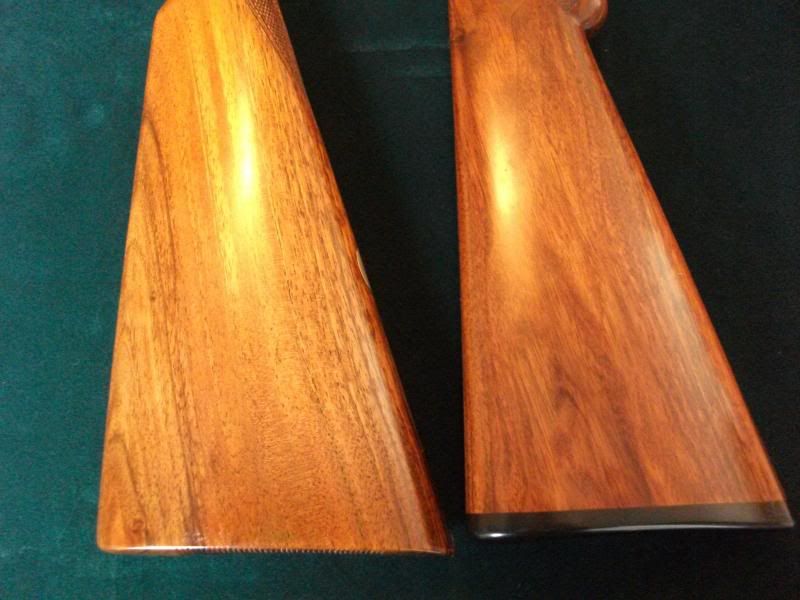
Last edited by damascus; 11/15/13 06:32 PM.
The only lessons in my life I truly did learn from where the ones I paid for!
|
|
|
|
|
Joined: Mar 2012
Posts: 371 Likes: 41
Sidelock
|
|
Sidelock
Joined: Mar 2012
Posts: 371 Likes: 41 |
lmii.com, a luthier's supply house in CA sells shellac flakes in 5 shades and also gives french polish information. The flakes are mixed into alcohol to make the amount of shellac you need for a project.
Sam Welch
|
|
|
|
|
Joined: Mar 2013
Posts: 2,862
Sidelock
|
|
Sidelock
Joined: Mar 2013
Posts: 2,862 |
Shellac.net is the best place to buy shellac that I've found so far. They have a wide variety available, as well as instructional resources on how to properly French Polish.
I prefer wood to plastic, leather to nylon, waxed cotton to Gore-Tex, and split bamboo to graphite.
|
|
|
|
|
Joined: May 2010
Posts: 1,550 Likes: 116
Sidelock
|
|
Sidelock
Joined: May 2010
Posts: 1,550 Likes: 116 |
Hi Joe gunman has given you the correct finish used on 1950s 700s at Webley’s the French polish used was ‘Garnet French Polish’ and Linseed oil. The idea of the French polish was the shellac stopped the oil from soaking to far in to the surface so speeding up the finishing process and the Garnet colour darkened the wood a little. In the photograph are two Webley 700’s of the 1950s each with the standard type factory finish the stock on the left has a ‘Blond French Polish’ as the base fore the finish the stock on the right has ‘Garnet French Polish base with a little red oil added to the finish top coats. Webley & Scott 700s in the 1950s where a sound basic English boxlock shotgun made to a price with sound but plain timber and a finish to match. The stocks were oiled with linseed oil with Alkenett root to colour ,various stains were tried at various times to darken the wood as Webley used plain straight grain wood for ease of machining and general overall strength .Sometimes the stocks were fumed with ammonia to darken them . The polish of what ever type was only used to fill grain ,unless the stock was ordered with a polished finish ,the heads were polished as were the forend woods the wood behind the checkering being buffed with a leather pad and rotten stone to give a dull lustre finish . Guns for the US as the later 720 and 728 were frequently polished as ordered .
|
|
|
|
|
Joined: Jul 2009
Posts: 373 Likes: 7
Sidelock
|
|
Sidelock
Joined: Jul 2009
Posts: 373 Likes: 7 |
KY jon is spot on. You have to clean the old gunk off the stock first. I use mineral spirits and a clean white rag. After that you really do need to scruff the old finish a bit so that the new finish has something to hold on to. I do not use steel wool anymore. Try a finer sandpaper like 400 grit and just lightly go over the stock. You could also use one of the more coarse grades of Scotch Brite. This stuff is sweet. You will enjoy your gun, and protect that old English wood much better, with a new finish. Oh, and the English are always having guns "refreshed". They do not understand the American passion for original condition guns. Use 'em, refinish 'em and use 'em some more.
Regards,
Jeff
"We are men of action. Lies do not become us."
Wesley
|
|
|
|
|