|
S |
M |
T |
W |
T |
F |
S |
|
|
|
|
|
|
|
1
|
|
2
|
3
|
4
|
5
|
6
|
7
|
8
|
|
9
|
10
|
11
|
12
|
13
|
14
|
15
|
|
16
|
17
|
18
|
19
|
20
|
21
|
22
|
|
23
|
24
|
25
|
26
|
27
|
28
|
29
|
|
30
|
31
|
|
|
|
|
|
|
|
Forums10
Topics40,282
Posts573,114
Members14,687
| |
Most Online32,084
Jun 14th, 2026
|
|
|
|
Joined: Jul 2005
Posts: 7,066 Likes: 4
Sidelock
|

Sidelock
Joined: Jul 2005
Posts: 7,066 Likes: 4 |
Drew and Joe thank you both! This picture shows all of the barrel markings, just the serial number and "DE"  Best, Mike
Last edited by AmarilloMike; 12/04/07 08:35 PM.
I am glad to be here.
|
|
|
|
|
Joined: Oct 2006
Posts: 532 Likes: 1
Sidelock
|
|
Sidelock
Joined: Oct 2006
Posts: 532 Likes: 1 |
According to Graham Greener's book, The Greener Story, p. 22, 1903 was the last year that Damascus barrels were produced in Britain. If correct, substantially all Damascus barrels produced after 1903 were made in Liege, Belgium. I would not be too sure that the German invasion of Belgium ended the export of barrels from Liege to the U.S.. Commerce has a way of surviving war. For example, I have a set of Krupp barrels which made their way through Liege, clearly after August 1914, and ended up on one of the last Syracuse Lefevers to leave the factory in 1916 before Ithaca bought out Lefever Arms.
Rich
Rich
|
|
|
|
|
Joined: Nov 2005
Posts: 4,598
Sidelock
|
|
Sidelock
Joined: Nov 2005
Posts: 4,598 |
Mike,
No makers punch. In most cases it was filed away. Those are Lefever marks for a D grade ejector.
Rich is correct. The German invasion did not stop production post war. Cheaper high quality steel that was part of the ramped up war effort did. It took a few years.
Remember damascus was 1st sought out because it produced a barrel capable of handling heavier pressures. Eventually it simply became customary for many buyers. Kind of like beer and pretzels.
However, post WWI as the new cheap steel came into the market damascus production slowly died. Also Belgium experienced a period of inflation. The low wages that had driven their success for nearly 100 years were a thing of the past. The truly large mechanized companies had stopped making damascus in-house years earlier. By 1925 most of the great barrel works of the Nessonvaux valley stood empty. I believe the last commercial concern finally stopped about 1930.
To further back up what Joe stated, there are reports as early as 1866 from Birmingham about how Liege was out producing them. Rich, correct me if I am wrong, you know much more about Lefever than I do. I believe that at least a few Lefevers have Whitworth barrels.
Pete
|
|
|
|
|
Joined: Dec 2001
Posts: 12,743
Sidelock
|
|
Sidelock
Joined: Dec 2001
Posts: 12,743 |
The Belgian tubes were almost always finished black & white, while the English tubes were almost always brown & white. Is there any indication this would have an actual effect on a Lefever's finish. I have been under the impression that the bbls would have been imported as simple unfinished tubes & would have been asembled & finished by the US maker. The above would apply, I believe, to those guns imported into the US as finished guns, which was not the case with Lefevers, or the other American classics. Thus the origin of the tubes would have little bearing upon what finish was applied at the Lefever works. PS; Pete, Whitworth bbls were listed as the steel option for a number of years on the Optimus Grade, They may have been available on special order on other grades, but do not seem to be a regularly cataloged item.
Last edited by 2-piper; 12/04/07 11:55 PM.
Miller/TN
I Didn't Say Everything I Said, Yogi Berra
|
|
|
|
|
Joined: Jan 2006
Posts: 10,019 Likes: 621
Sidelock
|
|
Sidelock
Joined: Jan 2006
Posts: 10,019 Likes: 621 |
From Part II of Jean Puraye's article in May, 1976 American Rifleman
"Year after year, until 1914, thousands of damascus barrels were made in the Vesdre Valley and supplied to gunsmiths in Liege and throughout the whole world. Considerable consignments of "blank" barrels were also exported, mainly to England and the United States.
In the Liege region, the 1914-1918 War did irreparable damage to the luxury weapons industry and to damascus production in particular. The production of gun barrels ceased; machine tools were destroyed and raw material sources wrecked.
Immediately after the armistice the barrel-makers courageously set to work once more. They encountered serious difficulties..."
The article goes on to state that J. Delcour-Dupont started making damascus barrels again in 1924, but only until 1930.
Last edited by revdocdrew; 12/05/07 12:09 AM.
|
|
|
|
|
Joined: Nov 2005
Posts: 4,598
Sidelock
|
|
Sidelock
Joined: Nov 2005
Posts: 4,598 |
Miller,
You are correct of course. I never stated any where my friend that finished barrels were being shipped. The problem with talking about a Lefever or Parker is that we speak in generalities and compress decades sometimes generations into a single sentence. A simple question gets asked and one seeks to supply a simple answer.
We can be fairly confident that struck barrels were not being shipped. Belgian proof law would have stepped in and we would be seeing more than a occasional maker's punch.
I keep getting told that British barrels are browned. I have never seen examples of Belgian barrels being browned. If your experience is different, please share it. I would like to learn.
Pete
|
|
|
|
|
Joined: Dec 2001
Posts: 12,743
Sidelock
|
|
Sidelock
Joined: Dec 2001
Posts: 12,743 |
Pete;
Your assesment concurs with my general understanding of bbl finishes. My only point was that color of finish could not be used to determine origin of Lefever tubes, as they would have had the finish applied here in the US. Often times we do not come acros with what we really mean to say. I had no conception that was what you were meaning, was just fearful it could be construed as that.
Miller/TN
I Didn't Say Everything I Said, Yogi Berra
|
|
|
|
|
Joined: Dec 2007
Posts: 5
Boxlock
|
|
Boxlock
Joined: Dec 2007
Posts: 5 |
Maybe you could help me. How do I post a question? I can only seem to find how to answer one, not ask one. Sorry to bother you. Thank you for any help you can give me.
My father passed away last year. I am having trouble identifying some of his guns and their values.
|
|
|
|
|
Joined: Jan 2002
Posts: 7,726 Likes: 129
Sidelock
|
|
Sidelock
Joined: Jan 2002
Posts: 7,726 Likes: 129 |
Click the "New Topic" icon at the top of the page under "Topic Options"...Geo
Last edited by Geo. Newbern; 12/05/07 12:01 PM.
|
|
|
|
|
Joined: Nov 2005
Posts: 4,598
Sidelock
|
|
Sidelock
Joined: Nov 2005
Posts: 4,598 |
Pete;
Your assessment concurs with my general understanding of bbl finishes. My only point was that color of finish could not be used to determine origin of Lefever tubes, as they would have had the finish applied here in the US. Often times we do not come across with what we really mean to say. I had no conception that was what you were meaning, was just fearful it could be construed as that. Miller, I understand perfectly well. I also appreciate the huge amount that you have generously shared over the years. If any one is wondering what I am talking about, take a look at the FAQ about Twist vs Damascus. http://www.doublegunshop.com/forums/ubbt...660df792#UNREAD Take a good look at who the posters are in that one!  Besides, you always find my basic math errors!!  It is difficult, given the format of a BBS to communicate some things properly. This is especially true with my rather terse responses at times. To restate what Miller said. To the best of my knowledge there were never any damascus barrels shipped in a finished state to American makers. During the "Golden Era" of this trade, the US had imposed tariffs on imports. A rough barrel had a lower tariff. At least at some of the time...as congress kept changing the tariff laws for nearly 40 years. I have posted this one before. A very early 14ga Barber-Lefever (still kicking myself for not buying it...) If those barrels are "untouched", I would love to hear a description of the color. 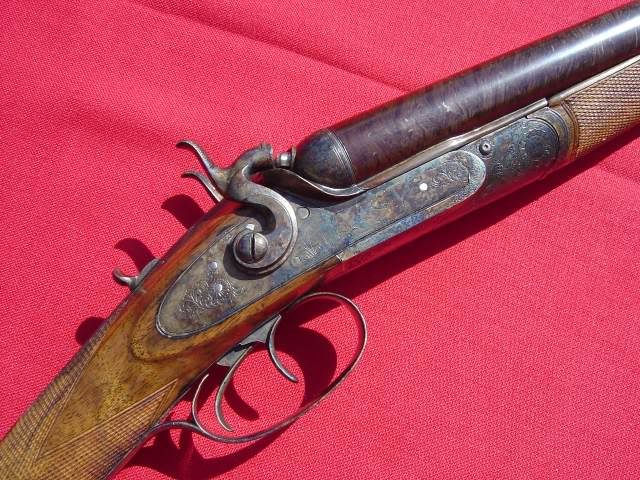 I need to shoot you an email on another matter. You may find it interesting. Pete
|
|
|
|
|

